
What We Heard in Lake Charles: Takeaways from the 2026 Americas LNG Summit
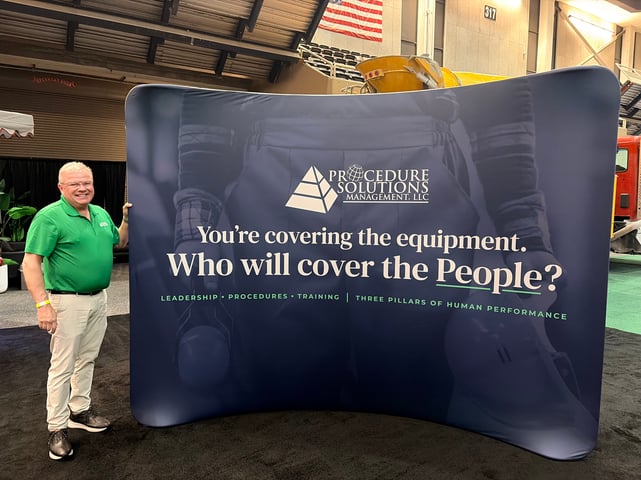
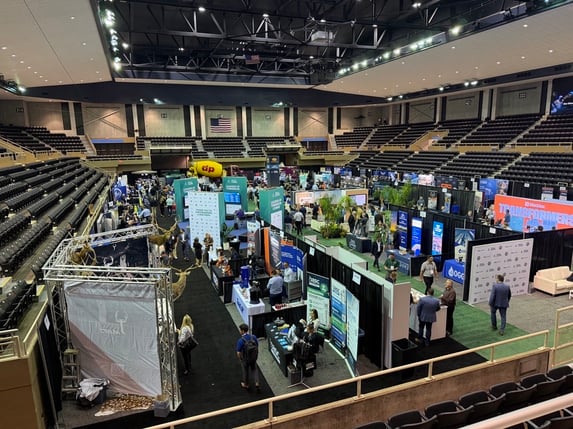
Our team spent October 13-15 at the 2026 Americas LNG Summit & Exhibition in Lake Charles, Louisiana, exhibiting at Booth B34 and presenting on the LNG Innovation & Workforce Stage. Across three days of sessions, booth conversations, and hallway exchanges, one message kept surfacing: the Gulf Coast is building LNG capacity faster than ever, and the people and procedures needed to run those facilities safely are working hard to keep pace.
If you stopped by our booth, thank you. This post is our way of picking up where those conversations left off, and of sharing what we learned with everyone who could not be in the room.
Can AI write safe operating procedures? Steve McCord’s answer on the Innovation & Workforce Stage
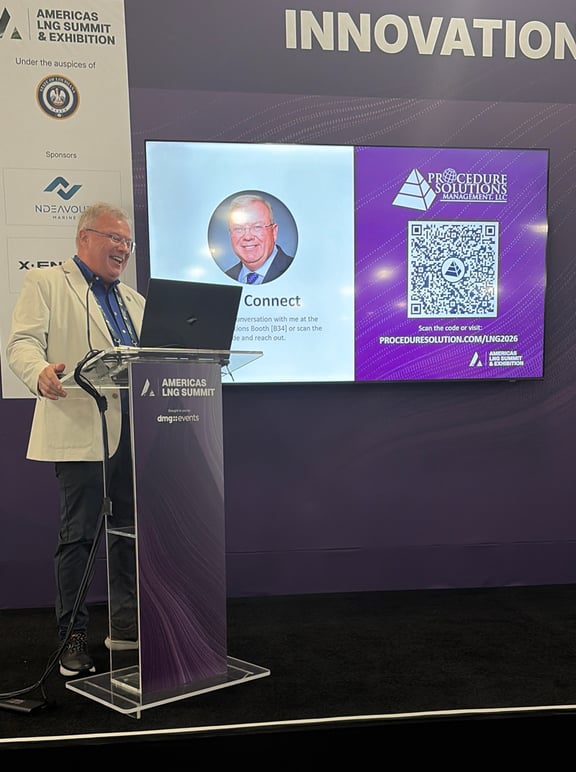
On the summit’s final afternoon, our Founder and Chairman, Steve McCord, took the LNG Innovation & Workforce Stage as part of its session on workforce development, competency, and training. His talk, “The Illusion of Competence: Why AI-Generated Procedures Pass the Visual Test but Fail the Human Performance Test,” came down to one message: AI can draft a procedure that looks finished, but it cannot validate one, and accountability for a procedure always stays with the person who signs it.
Steve has spent more than four decades in high-consequence operations and helped develop the industry guidance for human-factored procedure writing, so he approached the question the way a procedure professional would. He did not ask whether AI-written procedures look right. He asked whether they would hold up in the hands of a qualified but inexperienced operator on a difficult day.
Three points stood out:
- Generating is not validating. Steve put two AI-generated versions of the same tagout procedure side by side. Both looked professional, with clean structure and a confident tone, and he walked the room through the differences a trained writer would catch before either one reached the field.
- Some failure modes are beyond AI’s reach. Steve walked through seven that AI cannot resolve on its own, including cognitive load calibration, decision point clarity, conditional logic, and the placement of warnings. These are human performance judgments, not formatting choices.
- Duty of Care does not transfer to the tool. AI is best treated as a drafting assistant, not a procedure authority. Writers can work with AI, but the professional who reviews and signs off on a procedure bears responsibility for its fitness for use, not the tool that drafted it.
The takeaway for LNG teams is not to avoid AI. It is to bring AI into procedure work with the same discipline you would apply to any other change in a safety-critical process: defined review, qualified sign-off, and a clear line of accountability.
Want the side-by-side comparison:
What is an error trap? Our Spot the Error Trap Challenge
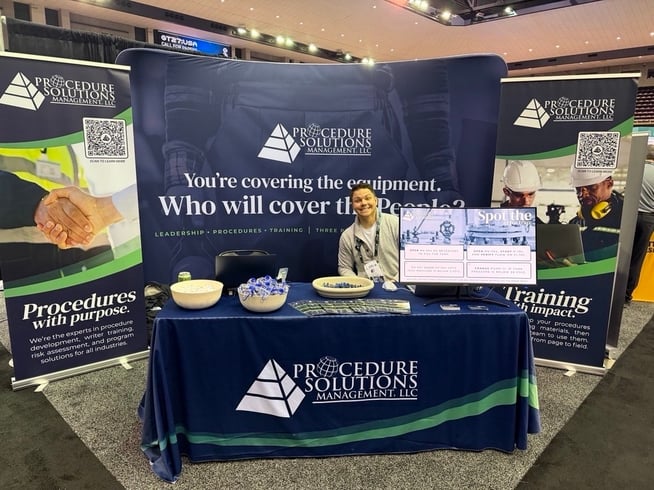
An error trap is a condition built into the wording or structure of a procedure that makes a mistake more likely, even for a careful, qualified worker. To show how easily they slip past experienced eyes, we set one at our booth. Visitors saw four short procedure steps on screen and one question: which example has the error trap?
- A. Open [valve] as necessary to fill the tank.
- B. Open [valve], start [pump], and verify flow on [gauge].
- C. Do not close [valve] until tank pressure is below [X].
- D. Charge [pump], if tank pressure is below [X].
Whichever one you picked, the screen said “Correct!” Then came the twist: they were all wrong, and each one fails for a different reason.
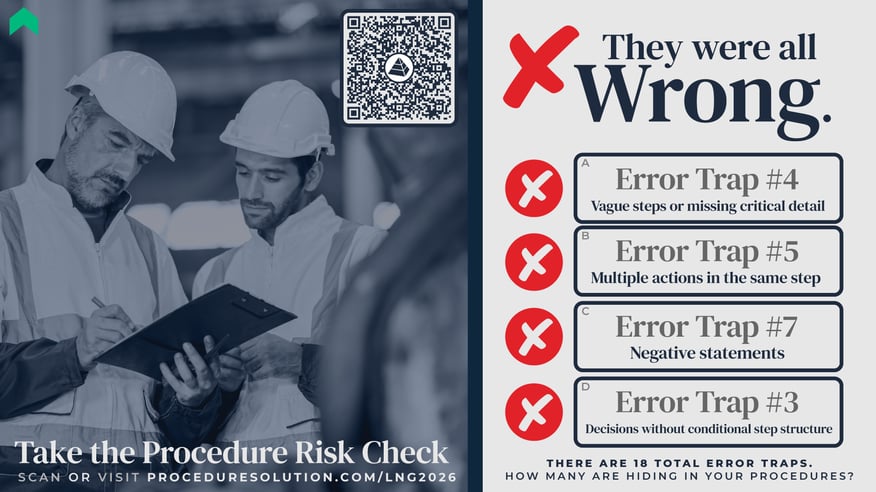
- A is a vague step. “As necessary” gives no target, no indication, and no stopping point.
- B packs three actions into one step. Mark it complete and you have signed off on all three, including the one you skipped.
- C is a negative statement. Miss one word, “not,” and the step tells you to do the opposite.
- D buries the decision. The condition comes after the action, so the pump may already be running before the reader reaches the “if.”
More than 30 visitors took the challenge over two days. Answers spread across all four options, with B, the multiple-action step, drawing the most votes. Only one person brought the questioning attitude the exercise was built to reward and guessed that all four steps contained an error trap. Congratulations to Sam from MSelect, the only visitor all week to call it.
That result is the whole point. The errors that slip through are rarely obvious at face value. They are small habits of writing that experienced people read past, because they already know what the procedure is supposed to say. An operator reading it for the first time does not have that advantage. These four are only a sample of the 18 error traps recognized by the Procedure Professionals Association, which is why we write and review procedures to a standard, not to memory.
Want to see where your own procedures stand? Take our two-minute Procedure Risk Check here:
From the Sessions: What Cheniere said about building resilient Gulf Coast supply chains
One session Steve attended stood out: Cheniere’s look at what it takes to keep Gulf Coast LNG reliable as the region grows. The headline was a shift in focus. The industry is moving from building capacity to sustaining reliability, and reliability depends on equipment, materials, and a skilled workforce all at once.
With six newly sanctioned projects on the Gulf Coast competing for the same people and long-lead equipment, the speaker described four risks stacking on top of each other:
- Labor competition. Data center construction is pulling the same pipefitters, technicians, and scaffolders, often with better working conditions.
- Global logistics disruption. Problems at the Panama Canal and the Suez Canal ripple into project schedules.
- Equipment constraints. Electronics and aerospace demand compete for helium, turbomachinery, and critical parts.
- A retirement wave. Experienced people across the skilled workforce are leaving faster than they are being replaced.
The recommended response was practical: map bottlenecks and single points of failure instead of only managing spend, bring engineering and procurement together early in design, give front-line teams clear decision rights, share demand forecasts with suppliers early, and manage suppliers by tier, from transactional to core to strategic partners. Cheniere has backed local engagement with real numbers, working with 150 Louisiana suppliers for more than $400 million in spend since 2024.
One answer in the Q&A was especially useful for smaller firms. New suppliers are encouraged to enter through large general contractors such as Bechtel and Zachry, which provide HSE oversight and a smoother onboarding path.
Two of those themes landed close to home for us. Clear decision rights only work when the procedure makes each decision point clear. A retirement wave is only survivable when what experienced people know has been written down.
What We Heard, and Where We Fit
The sessions described the problem from the top. Our booth conversations described it from the field. Three things came up again and again.
The gap between built and running is expensive. One leader told us a finished facility can sit six months to a year before it operates, while training manuals and procedures are translated, improved, and proven safe. Every month in that gap is lost revenue.
Procedure writing is a specialized skill. More than one project team told us they have deep engineering and construction talent but little procedure writing expertise in house.
Knowledge is walking out the door. When experienced operators retire, what they know has to live somewhere. If it is not in a procedure, it is gone.
This is the work Procedure Solutions Management was built for. We strengthen the three pillars of human performance: leadership, procedures, and training. A weakness in any one undermines the others. For LNG project and operations teams, that means:
- Procedures ready at startup. Our writers and subject matter experts develop and validate operating procedures alongside construction, so they are field-ready when the facility is.
- Training that transfers. The same experts who write your procedures build and deliver the training that supports them, so your teams learn exactly which errors each step was written to prevent.
- Experts on demand. Our SME bench adds capacity to project teams that have the technical depth but need procedure expertise.
- Capability that stays. Our PPA Writer Certification Training builds procedure writing skill inside your own team.
- A higher standard. Our methods come from nuclear and DOE work, where a procedure error is never a small error.
We have done this at Gulf Coast scale. At a major LNG export facility, our analysts reviewed and rewrote roughly 1,800 pages of plant operations, pipeline operations, and maintenance procedures against the governing standards, removing human performance error traps without changing technical content.
A word of thanks
For Steve, Lake Charles was more than another conference. As he put it on the flight home:
“I can’t say enough about how proud I was to think about how far we have come since Darlene and I tried to figure out what this company should even be called back in 2008. Each of you had a part in this. Without you, it would not have been possible.”
That gratitude extends to everyone who made the week what it was: the Americas LNG Summit team, the City of Lake Charles, every visitor who stopped by Booth B34, and everyone who attended Steve's talk at the Innovation & Workforce Stage. The mission that brought us here is the same one that started this company: making sure everyone goes home safe at the end of the day.
Let's Keep the Conversation Going
The Gulf Coast is entering its busiest building cycle in a generation. The facilities that start up on time and run reliably will be the ones whose people and procedures were ready on day one.
If we met in Lake Charles, we would love to pick up where we left off. If we did not get the chance to meet, we would still like to hear what you are building and how we can support it.
Frequently asked questions
Can AI write operating procedures for LNG facilities?
AI can draft procedure text quickly, but it cannot validate it. AI-generated procedures often look complete while still containing human performance problems such as unclear decision points, poorly placed warnings, and steps that overload the reader. A qualified procedure writer must review and sign off, because accountability stays with the person, not the tool.
What is an error trap in a procedure?
An error trap is a condition in a procedure’s wording or structure that makes a mistake more likely. Common examples include vague steps, multiple actions combined into one step, negative statements, and conditions placed after the action they control. The Procedure Professionals Association recognizes 18 error traps.
Why do new LNG facilities need procedures ready before startup?
A facility cannot operate safely until its operating and maintenance procedures are validated and its operators are trained on them. When procedures lag behind construction, startup can slip by months. Developing procedures alongside construction closes that gap.
What is PPA Writer Certification Training?
It is training that prepares procedure writers for the Procedure Professionals Association’s writer certification exam, covering human-factored writing, error traps, and performance modes. Procedure Solutions Management is an authorized provider of the training; the certification itself is administered by the PPA.